

Written by Spiro Koulouris | Medically Reviewed by Dr. Muhammad Qousain Ali, Consultant Rheumatologist on April 2, 2026
Willkommen in meinem Blog über GOUT!
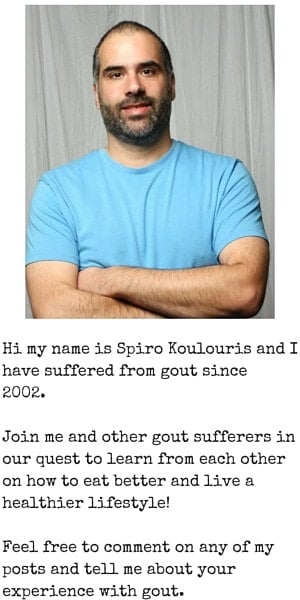
My name is Spiro Koulouris and I suffer from gout. Considered one of the most painful of the rheumatic conditions, gout afflicts approximately 1–4% of adults globally (roughly 57 million people) and is one of the most common forms of inflammatory arthritis. As a gout sufferer for over 15 years now, it can be quite a “pain in the toe” in having to deal with this disease or disorder if you prefer.
I remember when I was first diagnosed with it, how shocked and stressed I was, thinking my doctor had made a grave mistake and that I needed a second opinion. Then reality sunk in and my new life began, living with this disease. I remember I was given the drugs Colchicin und Allopurinol. I was told by my doctor that colchicine is for the acute attacks but I had to take Allopurinol for the rest of my life, which many patients need to take long-term depending on their disease severity and uric acid levels. I recall the diarrhea the Colchicine gave me a few times a day and then stopping to take it and telling my doctor that I’ll only stick to Allopurinol 200mg a day. I rebelled against my doctor’s demands and had become my own doctor, struggling to battle and overtake this disease by experimenting with my prescription drug dosage and eating habits more importantly but to no avail. All I got was more gout attacks.
I’ve bought pill cutters slicing my Allopurinol daily intake to 100 mg and then down to 50 mg without my doctor’s consent, I’ve even stopped it completely thinking I had it beat a couple times with good dieting, only to get an attack and go back to the drawing board trying to figure out what I did wrong, what foods I ate the last several days, what did I drink the last few days and have noticed whenever I get an attack, alkoholische Getränke kam in den letzten Tagen ins Spiel.
That is my personal gout trigger. Even a glass of wine with my meal but usually I had 2-4 days of drinking a couple of beers, then the next day a glass of wine, nothing like a drinking binge with friends at the local bar or anything like that; just a couple of drinks did the trick for me to get a painful gout attack in my right toe and having my wife yelling at me “You don’t take your pills…What are you, your own doctor?…You like to suffer like that?….Spiro I can’t see you like this!…” and so on.
Psychologically it screws with your mind, being so young and having to deal with this handicap by walking with a cane and limping in embarrassment, having to explain yourself to family and friends, what gout is and how you got it. Makes you feel defeated, having friends tell you: “You got rich man’s disease Spiro, cut the burgers and Coke!” It’s true when I got my first gout attack I was 240 pounds, about 50 pounds overweight for a 5’11 guy, eating Big Macs, lots of fries and loved to drink a can of Coca-Cola in the afternoons so the caffeine and Zucker kann mich auf der Arbeit für die letzte Etappe des Tages wach machen. Ich wusste nicht, dass ich mit dieser Dose Coca-Cola etwa 9 Teelöffel Zucker (etwa 39 Gramm) zu mir nahm, die gesamte empfohlene tägliche Zuckermenge für Männer an einem Tag!!!
Many doctors and health practitioners have recently studied and concluded how “fructose corn syrup” may be causing so many health problems for us today. Here’s a great explanation from some fellow at wiki.answers.com:
“Gout is triggered by the presence of crystals of uric acid in your joints. It extremely painful. Many people with gout have high levels of uric acid in their blood stream. Oddly enough some people with gout do not have high levels of uric acid in their blood. Dig deeper.
Fructose is an unusual sugar for humans to eat. We have no system to break down fructose polymers. The only sources of fructose we can use are the simple sugar in fruit or honey and as the molecule combined with glucose as sucrose, i.e. table sugar. Drenching your metabolism with fructose is a recent innovation for humans. The current preferred sweetener for soft drinks is “high fructose corn syrup”, a product of our dearly beloved food industry in the last thirty years or less.

What happens when you drench your metabolism with fructose?
Sie tritt in den Kohlenhydrat-Stoffwechselweg unterhalb der Hauptsteuerungsstufe ein und wird sofort in Fruktose-1-Phosphat umgewandelt. Warum die Evolution die Dinge so angeordnet hat, ist ein Rätsel, aber mein Verdacht ist, dass die Evolution freie Fruktose im menschlichen Stoffwechsel nicht mag. Wenn Sie also einen kleinen Eimer Cola trinken, gelangen 100 g Fruktose in Ihre Leber. Dies erfordert eine hohe Zufuhr von Phosphat für das Fruktose-1-Phosphat, so dass nur sehr wenig für die Erzeugung von Adenosintriumphosphat (ATP), der primären Energiewährung unserer Zellen, übrig bleibt. Ein ATP-Mangel löst die Aktivität des Adenin-Abbausystems und die Produktion von - raten Sie mal - Harnsäure aus! Gicht, und keine Portion Nieren in Sicht. Bis vor 100 Jahren konnten sich nur die Reichen genug Zucker leisten, um Gicht zu bekommen, heute ist sie ein Merkmal des metabolischen Syndroms und für alle zugänglich.
Im Übrigen muss die Fruktose irgendwo hin, und zwar in das Fett, das über erhöhte Triglyceridwerte im Blut gespeichert wird. Es verursacht auch eine Insulinresistenz. Sogar das vollständige metabolische Syndrom!
Wahrscheinlich ist es sogar so, dass Fruktose eine Insulinresistenz verursacht, die wiederum Gicht auslösen kann. Die Hyperurikämie und die Tatsache, dass die Gelenke Harnsäurekristalle produzieren, müssen nicht kausal zusammenhängen. Ich würde sagen, sie sind es nicht."
Außerdem ist eine Studie aus dem Jahr 2008 durch die Britisches Ärzteblatt ergab, dass Männer, die täglich 2 oder mehr Softdrinks tranken, ein 85% höheres Risiko hatten, an Gicht zu erkranken, als Männer, die weniger als eine Limonade pro Monat tranken. Der Zusammenhang zwischen alkoholfreien Getränken und Gicht ist also sehr stark, liebe Gichtkranke.
Es gibt den Staatsfeind #1, Zucker in Form von Maissirup mit hohem Fruktosegehalt. Das macht Sinn, denn immer wenn ich einen Gichtanfall hatte, habe ich ein paar Stunden vorher ein paar Jack Daniels Whisky und Cola getrunken. Aber jeder Mensch ist anders, wie ich recherchiert habe. Gichtkranke auf der ganzen Welt bekommen ihre Anfälle, wenn sie verschiedene Lebensmittel und Getränke essen und trinken, aber ein gemeinsamer Nenner, den ich bei anderen Betroffenen festgestellt habe, ist, dass Maissirup mit hohem Fruchtzuckergehalt die Nieren auf der ganzen Welt stark geschädigt hat und der Hauptverursacher dieses eskalierenden Problems ist, bei dem die Zahl der Männer und Frauen, bei denen Gicht diagnostiziert wurde, stetig zugenommen hat.
I still take my allopurinol dose every day now at 100 mg to play it safe but I’ve found the right diet plan to keep those uric acid levels low through tons of blood experiments with my body and unfortunately I’ve discovered that since I also suffer from minor thalassemia, I am more prone to higher uric acid levels than the average person without any other conditions. Obviously, this is something that is genetic and hard to beat by diet alone for me that is but for you it could be a whole different story.
Seien Sie also herzlich willkommen, kommentieren Sie, erforschen Sie, experimentieren Sie und erzählen Sie uns Ihre Geschichte über das Leben mit Gicht. Ich gebe nicht vor, alles zu wissen und ein Experte auf dem Gebiet der Gicht zu sein. Wenn Sie also etwas über ein bestimmtes Thema der Gicht wissen, können Sie es hier gerne mit anderen teilen und miteinander diskutieren, um mehr über diese Krankheit zu erfahren. Am Ende geht es darum, die Gicht endlich zu besiegen und ein gesundes Leben ohne diese Krankheit zu führen.
Ich wünsche Ihnen viel Spaß mit diesem Blog!
HAFTUNGSAUSSCHLUSS
This article is for educational purposes only and should not replace medical advice. Patients should consult their physician for individual management.

 German
  English
  French
  Spanish