

Written by Spiro Koulouris | Medically Reviewed by Dr. Muhammad Qousain Ali, Consultant Rheumatologist on April 2, 2026
¡Bienvenidos a mi blog sobre la GOTA!
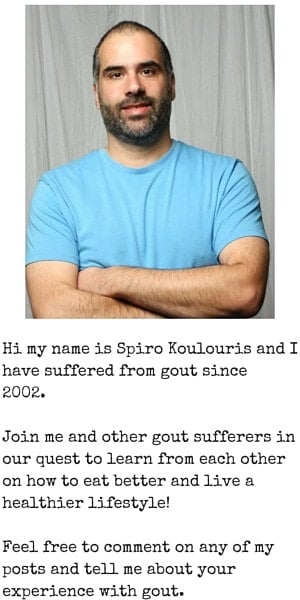
My name is Spiro Koulouris and I suffer from gout. Considered one of the most painful of the rheumatic conditions, gout afflicts approximately 1–4% of adults globally (roughly 57 million people) and is one of the most common forms of inflammatory arthritis. As a gout sufferer for over 15 years now, it can be quite a “pain in the toe” in having to deal with this disease or disorder if you prefer.
I remember when I was first diagnosed with it, how shocked and stressed I was, thinking my doctor had made a grave mistake and that I needed a second opinion. Then reality sunk in and my new life began, living with this disease. I remember I was given the drugs Colchicina y Allopurinol. I was told by my doctor that colchicine is for the acute attacks but I had to take Allopurinol for the rest of my life, which many patients need to take long-term depending on their disease severity and uric acid levels. I recall the diarrhea the Colchicine gave me a few times a day and then stopping to take it and telling my doctor that I’ll only stick to Allopurinol 200mg a day. I rebelled against my doctor’s demands and had become my own doctor, struggling to battle and overtake this disease by experimenting with my prescription drug dosage and eating habits more importantly but to no avail. All I got was more gout attacks.
I’ve bought pill cutters slicing my Allopurinol daily intake to 100 mg and then down to 50 mg without my doctor’s consent, I’ve even stopped it completely thinking I had it beat a couple times with good dieting, only to get an attack and go back to the drawing board trying to figure out what I did wrong, what foods I ate the last several days, what did I drink the last few days and have noticed whenever I get an attack, bebidas alcohólicas han entrado en juego en los últimos días.
That is my personal gout trigger. Even a glass of wine with my meal but usually I had 2-4 days of drinking a couple of beers, then the next day a glass of wine, nothing like a drinking binge with friends at the local bar or anything like that; just a couple of drinks did the trick for me to get a painful gout attack in my right toe and having my wife yelling at me “You don’t take your pills…What are you, your own doctor?…You like to suffer like that?….Spiro I can’t see you like this!…” and so on.
Psychologically it screws with your mind, being so young and having to deal with this handicap by walking with a cane and limping in embarrassment, having to explain yourself to family and friends, what gout is and how you got it. Makes you feel defeated, having friends tell you: “You got rich man’s disease Spiro, cut the burgers and Coke!” It’s true when I got my first gout attack I was 240 pounds, about 50 pounds overweight for a 5’11 guy, eating Big Macs, lots of fries and loved to drink a can of Coca-Cola in the afternoons so the caffeine and azúcar puede despertarme en el trabajo para la última etapa del día. Lo que no sabía era que al beber esa lata de Coca-Cola, estaba ingiriendo alrededor de 9 cucharaditas de azúcar (aproximadamente 39 gramos), ¡la cantidad total de azúcar diaria recomendada para los hombres en un solo día!
Many doctors and health practitioners have recently studied and concluded how “fructose corn syrup” may be causing so many health problems for us today. Here’s a great explanation from some fellow at wiki.answers.com:
“Gout is triggered by the presence of crystals of uric acid in your joints. It extremely painful. Many people with gout have high levels of uric acid in their blood stream. Oddly enough some people with gout do not have high levels of uric acid in their blood. Dig deeper.
Fructose is an unusual sugar for humans to eat. We have no system to break down fructose polymers. The only sources of fructose we can use are the simple sugar in fruit or honey and as the molecule combined with glucose as sucrose, i.e. table sugar. Drenching your metabolism with fructose is a recent innovation for humans. The current preferred sweetener for soft drinks is “high fructose corn syrup”, a product of our dearly beloved food industry in the last thirty years or less.

What happens when you drench your metabolism with fructose?
Entra en la vía metabólica de los carbohidratos por debajo de su paso de control principal y se convierte inmediatamente en fructosa-1-fosfato. La razón exacta por la cual la evolución ha dispuesto las cosas de esta manera es un misterio, pero sospecho que la evolución no tolera la presencia de fructosa libre en el metabolismo humano. Por lo tanto, beber un pequeño cubo de cola introduce 100 gramos de fructosa en tu hígado. Esto requerirá una gran cantidad de fosfato para formar fructosa-1-fosfato, dejando muy poco para la generación de adenosín trifosfato (ATP), la principal moneda energética de nuestras células. La falta de ATP desencadena la actividad del sistema de degradación de la adenina y la producción de, ¿adivina qué?, ¡ácido úrico! La gota, y ni una porción de riñones a la vista. Hasta hace 100 años, solo los ricos podían permitirse suficiente azúcar para desarrollar gota, ahora es una característica del síndrome metabólico y está al alcance de todos.
Por cierto, la fructosa tiene que ser "almacenada" en alguna parte, y eso se convierte en grasa para su almacenamiento, a través de niveles elevados de triglicéridos en la sangre. También causa resistencia a la insulina. ¡Incluso puede llevar al síndrome metabólico completo!
De hecho, es probable que la verdad sea que la fructosa causa resistencia a la insulina, lo que puede llevar a la gota. La hiperuricemia y el hecho de que las articulaciones produzcan cristales de ácido úrico no necesariamente tienen que estar relacionados causalmente. Yo diría que no lo están.
Furthermore, a estudio publicado en 2008 by the Revista médica británica Encontré que los hombres que bebían 2 o más refrescos al día tenían un riesgo un 85% mayor de desarrollar gota en comparación con los hombres que bebían menos de 1 refresco al mes. Por lo tanto, la correlación entre los refrescos y la gota es muy fuerte, mi compañero sufridor de la gota.
¡Aquí tienes la traducción al español de tu texto! "Existe un enemigo público número uno, el azúcar en forma de jarabe de maíz con alto contenido de fructosa. Tiene sentido, porque cada vez que sufría un ataque de gota, solía tomar unos cuantos whiskies Jack Daniels con Coca-Cola unas horas antes. Pero todos somos diferentes según mi investigación; los afectados por la gota en todo el mundo sufren ataques por comer y beber diferentes alimentos y bebidas. Sin embargo, hay un factor común que he notado entre otros afectados, y es que el jarabe de maíz con alto contenido de fructosa puede haber causado muchos daños a los riñones en todo el mundo, y es el principal culpable de este problema creciente en el que se ha observado un aumento constante en hombres y mujeres diagnosticados con gota."
I still take my allopurinol dose every day now at 100 mg to play it safe but I’ve found the right diet plan to keep those uric acid levels low through tons of blood experiments with my body and unfortunately I’ve discovered that since I also suffer from minor thalassemia, I am more prone to higher uric acid levels than the average person without any other conditions. Obviously, this is something that is genetic and hard to beat by diet alone for me that is but for you it could be a whole different story.
¡Bienvenido! Siéntete libre de comentar, explorar, experimentar y compartir tu historia sobre vivir con gota. ¿Qué te provoca los ataques, qué éxitos has logrado con tu salud, qué fracasos has aprendido? No pretendo saberlo todo ni ser un experto en la gota, así que si tienes conocimientos sobre algún tema relacionado con esta enfermedad, siéntete libre de compartirlo aquí y debatir con los demás en busca de conocimiento sobre esta enfermedad. Al final, el objetivo es derrotarla finalmente y vivir una vida saludable sin este trastorno.
¡Espero que disfrutes este blog!
AVISO LEGAL
This article is for educational purposes only and should not replace medical advice. Patients should consult their physician for individual management.



 Spanish
  English
  French
  German