

Written by Spiro Koulouris | Medically Reviewed by Dr. Muhammad Qousain Ali, Consultant Rheumatologist on April 2, 2026
Bienvenue sur mon blog sur la GOUTTE !
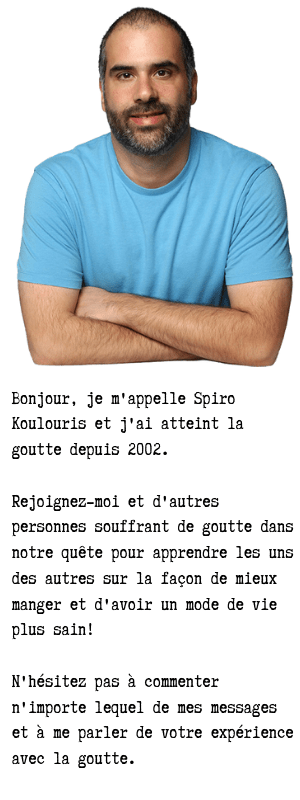
My name is Spiro Koulouris and I suffer from gout. Considered one of the most painful of the rheumatic conditions, gout afflicts approximately 1–4% of adults globally (roughly 57 million people) and is one of the most common forms of inflammatory arthritis. As a gout sufferer for over 15 years now, it can be quite a “pain in the toe” in having to deal with this disease or disorder if you prefer.
I remember when I was first diagnosed with it, how shocked and stressed I was, thinking my doctor had made a grave mistake and that I needed a second opinion. Then reality sunk in and my new life began, living with this disease. I remember I was given the drugs Colchicine et l'Allopurinol. I was told by my doctor that colchicine is for the acute attacks but I had to take Allopurinol for the rest of my life, which many patients need to take long-term depending on their disease severity and uric acid levels. I recall the diarrhea the Colchicine gave me a few times a day and then stopping to take it and telling my doctor that I’ll only stick to Allopurinol 200mg a day. I rebelled against my doctor’s demands and had become my own doctor, struggling to battle and overtake this disease by experimenting with my prescription drug dosage and eating habits more importantly but to no avail. All I got was more gout attacks.
I’ve bought pill cutters slicing my Allopurinol daily intake to 100 mg and then down to 50 mg without my doctor’s consent, I’ve even stopped it completely thinking I had it beat a couple times with good dieting, only to get an attack and go back to the drawing board trying to figure out what I did wrong, what foods I ate the last several days, what did I drink the last few days and have noticed whenever I get an attack, les boissons alcoolisées entraient en jeu ces derniers jours.
That is my personal gout trigger. Even a glass of wine with my meal but usually I had 2-4 days of drinking a couple of beers, then the next day a glass of wine, nothing like a drinking binge with friends at the local bar or anything like that; just a couple of drinks did the trick for me to get a painful gout attack in my right toe and having my wife yelling at me “You don’t take your pills…What are you, your own doctor?…You like to suffer like that?….Spiro I can’t see you like this!…” and so on.
Psychologically it screws with your mind, being so young and having to deal with this handicap by walking with a cane and limping in embarrassment, having to explain yourself to family and friends, what gout is and how you got it. Makes you feel defeated, having friends tell you: “You got rich man’s disease Spiro, cut the burgers and Coke!” It’s true when I got my first gout attack I was 240 pounds, about 50 pounds overweight for a 5’11 guy, eating Big Macs, lots of fries and loved to drink a can of Coca-Cola in the afternoons so the caffeine and sucre sucre puissent me réveiller au travail pour la dernière ligne droite de la journée. Je ne savais pas qu'en buvant cette canette de Coca-Cola, j'avalais environ 9 cuillères à café de sucre (environ 39 grammes), la quantité recommandée de sucre quotidienne pour les hommes en une journée ! ! !
Many doctors and health practitioners have recently studied and concluded how “fructose corn syrup” may be causing so many health problems for us today. Here’s a great explanation from some fellow at wiki.answers.com:
“Gout is triggered by the presence of crystals of uric acid in your joints. It extremely painful. Many people with gout have high levels of uric acid in their blood stream. Oddly enough some people with gout do not have high levels of uric acid in their blood. Dig deeper.
Fructose is an unusual sugar for humans to eat. We have no system to break down fructose polymers. The only sources of fructose we can use are the simple sugar in fruit or honey and as the molecule combined with glucose as sucrose, i.e. table sugar. Drenching your metabolism with fructose is a recent innovation for humans. The current preferred sweetener for soft drinks is “high fructose corn syrup”, a product of our dearly beloved food industry in the last thirty years or less.

What happens when you drench your metabolism with fructose?
Le fructose entre dans la voie métabolique des glucides en dessous de son étape de contrôle principal et est immédiatement converti en fructose-1-phosphate. Pourquoi l'évolution a organisé les choses de cette manière est un mystère, mais je soupçonne que l'évolution n'aime pas le fructose libre dans le métabolisme humain. Ainsi, boire un petit seau de cola mettra 100 g de fructose dans votre foie. Cela nécessitera une grande quantité de phosphate pour le fructose-1-phosphate, en laissant très peu pour la génération d'adénosine triphosphate (ATP), la monnaie énergétique primaire de nos cellules. Un manque d'ATP déclenche l'activité du système de dégradation de l'adénine et la production, devinez quoi, d'acide urique! La goutte, sans même une portion de reins en vue. Jusqu'à il y a 100 ans, seuls les riches pouvaient se permettre suffisamment de sucre pour avoir la goutte, maintenant c'est une caractéristique du syndrome métabolique et accessible à tous.
D'ailleurs, le fructose doit être "stocké" quelque part, et c'est dans les graisses, via des niveaux élevés de triglycérides dans le sang. Il provoque également une résistance à l'insuline. Même le syndrome métabolique complet!
En fait, la vérité est probablement que le fructose cause une résistance à l'insuline, ce qui peut causer la goutte. L'hyperuricémie et le fait que les articulations produisent des cristaux d'acide urique ne doivent pas être causalement liés. Je dirais qu'ils ne le sont pas."
De plus, une étude publiée en 2008 dans le British Medical Journal a révélé que les hommes qui buvaient 2 ou plus de boissons gazeuses par jour avaient un risque de développer la goutte 85% plus élevé que les hommes qui buvaient moins d'une boisson gazeuse par mois. Ainsi, la corrélation entre les boissons gazeuses et la goutte est très forte, mon cher compagnon souffrant de la goutte.
Il y a l'ennemi public numéro 1, le sucre sous forme de sirop de maïs à haute teneur en fructose. Cela a du sens, car chaque fois que j'ai eu une crise de goutte, j'ai bu quelques Jack Daniels whisky et Cokes quelques heures avant. Mais tout le monde est différent, car d'après mes recherches, les personnes souffrant de la goutte à travers le monde ont des crises en mangeant et en buvant différents aliments et boissons, mais un dénominateur commun que j'ai remarqué chez d'autres patients est que le sirop de maïs à haute teneur en fructose peut avoir causé beaucoup de dommages aux reins dans le monde entier et est le principal coupable dans ce problème croissant où les hommes et les femmes diagnostiqués avec la goutte ont vu une augmentation constante.
I still take my allopurinol dose every day now at 100 mg to play it safe but I’ve found the right diet plan to keep those uric acid levels low through tons of blood experiments with my body and unfortunately I’ve discovered that since I also suffer from minor thalassemia, I am more prone to higher uric acid levels than the average person without any other conditions. Obviously, this is something that is genetic and hard to beat by diet alone for me that is but for you it could be a whole different story.
Alors bienvenue, n'hésitez pas à commenter, explorer, expérimenter et nous raconter votre histoire sur la vie avec la goutte. Ce qui la déclenche pour vous, quels succès avez-vous obtenus pour votre santé, quels échecs avez-vous appris ; je ne prétends pas tout savoir et être un expert en goutte, donc si vous avez des connaissances sur un sujet particulier sur la goutte, n'hésitez pas à les partager ici et à débattre les uns avec les autres dans la poursuite de la connaissance sur cette maladie. À la fin, le résultat final est de la vaincre enfin et de vivre une vie saine sans ce trouble.
J'espère que vous apprécierez ce blog !
CLAUSE DE NON-RESPONSABILITÉ
This article is for educational purposes only and should not replace medical advice. Patients should consult their physician for individual management.


 French
  English
  Spanish
  German